GCC Financial and Economic Cooperation Committee adopts a new methodology for calculating Excise Tax on Sweetened Beverages


The updated approach, which takes effect in Saudi Arabia from January 2026, replaces the current flat-rate model with a tiered system based on sugar content.
This reform is designed to promote fairness in taxation and support regional health objectives by encouraging lower-sugar consumption.
Currently, all sweetened beverages are subject to a 50% excise tax, regardless of their sugar content. Under the revised structure, excise tax will be determined according to the beverage’s sugar content per 100ml, as follows:
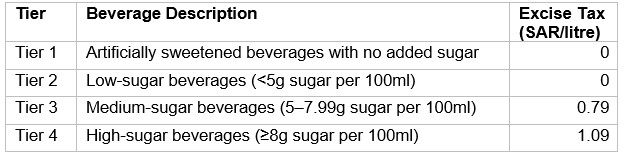
This reform reflects a broader regional trend towards behaviour-based taxation, rewarding producers that innovate towards healthier product formulations. For businesses operating in Saudi Arabia and the wider GCC, the change introduces several key considerations:
- Companies should assess their excise tax exposure and ensure systems are updated to capture sugar content data accurately.
- Manufacturers may consider reformulating products to fall within lower-sugar tiers.
- Retailers and distributors should model pricing impacts under the new tiered rates.
- Proper product classification and disclosure will become essential for audit readiness.
Our View
The introduction of a sugar-based excise framework marks an important shift in the GCC’s fiscal policy landscape. Beyond its public health objectives, it underscores the region’s commitment to transparent, data-driven taxation models.
As implementation approaches, our team can support clients in assessing their readiness, conducting impact analyses, and ensuring compliance with forthcoming ZATCA guidelines.