Rebuilding the Last Mile: From Fragmented Delivery to Shared, Circular Infrastructure

21 Apr 2026 2 min read

Across global markets, and particularly in the GCC, last-mile delivery accounts for a disproportionate share of logistics costs and emissions, often exceeding half of total delivery spend in urban environments.
At the same time, e-commerce growth continues to accelerate, placing increasing strain on already inefficient delivery networks. Incremental improvements, better routing, faster vehicles, and marginal cost savings are no longer sufficient. What is required is a redesign of the underlying infrastructure.
A Shift from Competition to Collaboration
The future of last-mile logistics will not be built on isolated carrier networks, but on shared ecosystems.
- Shared locker infrastructure reduces duplication and enables consolidated delivery
- Reusable tote systems transform packaging into a circulating asset rather than waste
- RFID-enabled tracking provides real-time visibility across the network
Together, these elements create a closed-loop system that is operationally efficient, commercially viable, and environmentally sustainable, not as a future concept, but as an emerging reality.
For retailers, logistics providers, real estate developers, and technology players, the question is no longer whether this shift will happen but how to position for it.
Early movers will define network standards, capture infrastructure advantages, and build capabilities that are difficult to replicate at scale.
How Grant Thornton Can Support
At Aldar Audit Bureau, Grant Thornton, we work with organisations to move beyond incremental optimisation and toward structural transformation.
Our support spans:
- Supply chain operating model redesign
- Last-mile infrastructure strategy and ecosystem partnerships
- Digital enablement, including data visibility and asset tracking
- Regulatory alignment within evolving GCC logistics frameworks
We help clients not only respond to this shift but also lead it, turning supply chains into a source of competitive advantage rather than an operational constraint.
In our latest article, we explore a fundamental shift already underway: the move from fragmented delivery systems to shared, circular infrastructure. Built on three converging components: shared locker networks, reusable packaging systems, and real-time digital tracking, this model represents a step-change in how supply chains are designed, not just optimised.
Authors
-

Sofia Raptopoulou
Sofia is an experienced Senior Supply Chain specialist with a strong operational background in the plastics and manufacturing sector. She specialises in end-to-end supply chain performance improvement, supporting clients in optimising warehouse operations, logistics flows, procurement processes and inventory management.View Profile
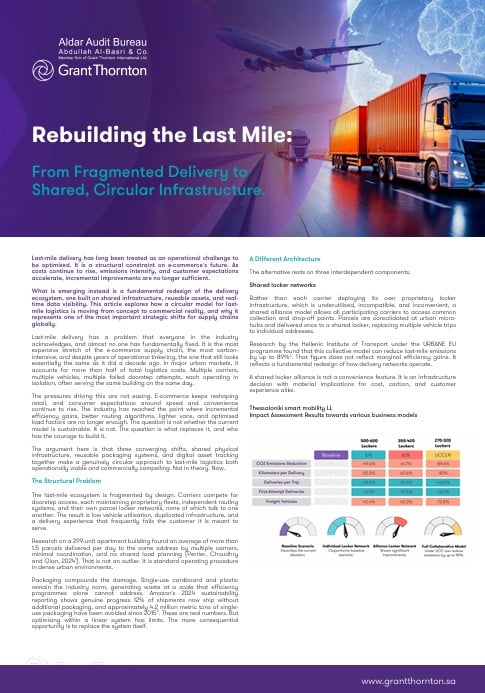
Rebuilding the Last Mile
Last-mile delivery has long been treated as an operational challenge to be optimised. It is a structural constraint on e-commerce's future. As costs continue to rise, emissions intensify, and customer expectations accelerate, incremental improvements are no longer sufficient.